
I am standing in Bar Kabinett, alone and awkward. The founder and staff are nowhere to be seen. It is early on a Tuesday morning, so the bar isn’t in service, but I’m due to meet its leading man, Oscar Jonsson Buhre.
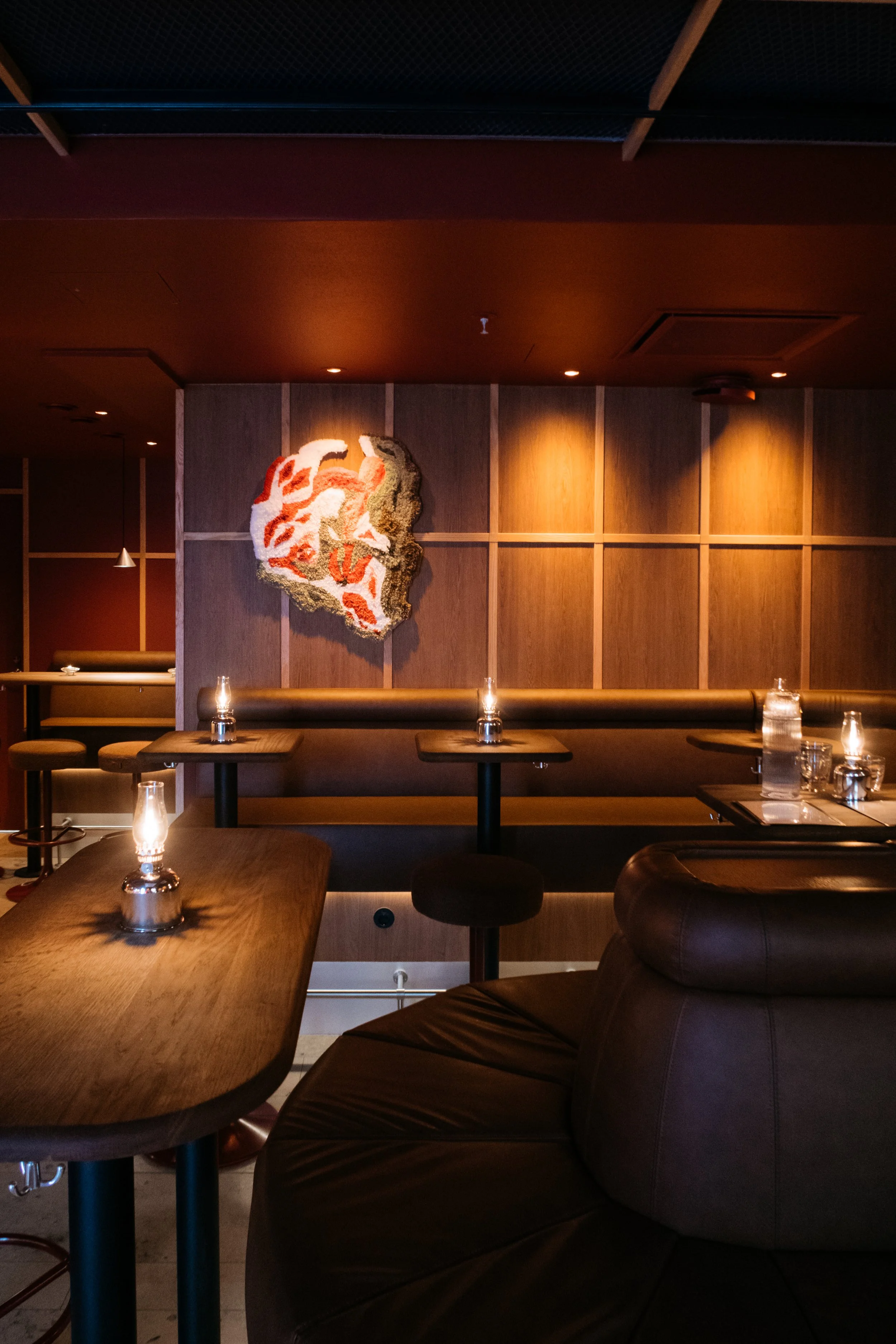
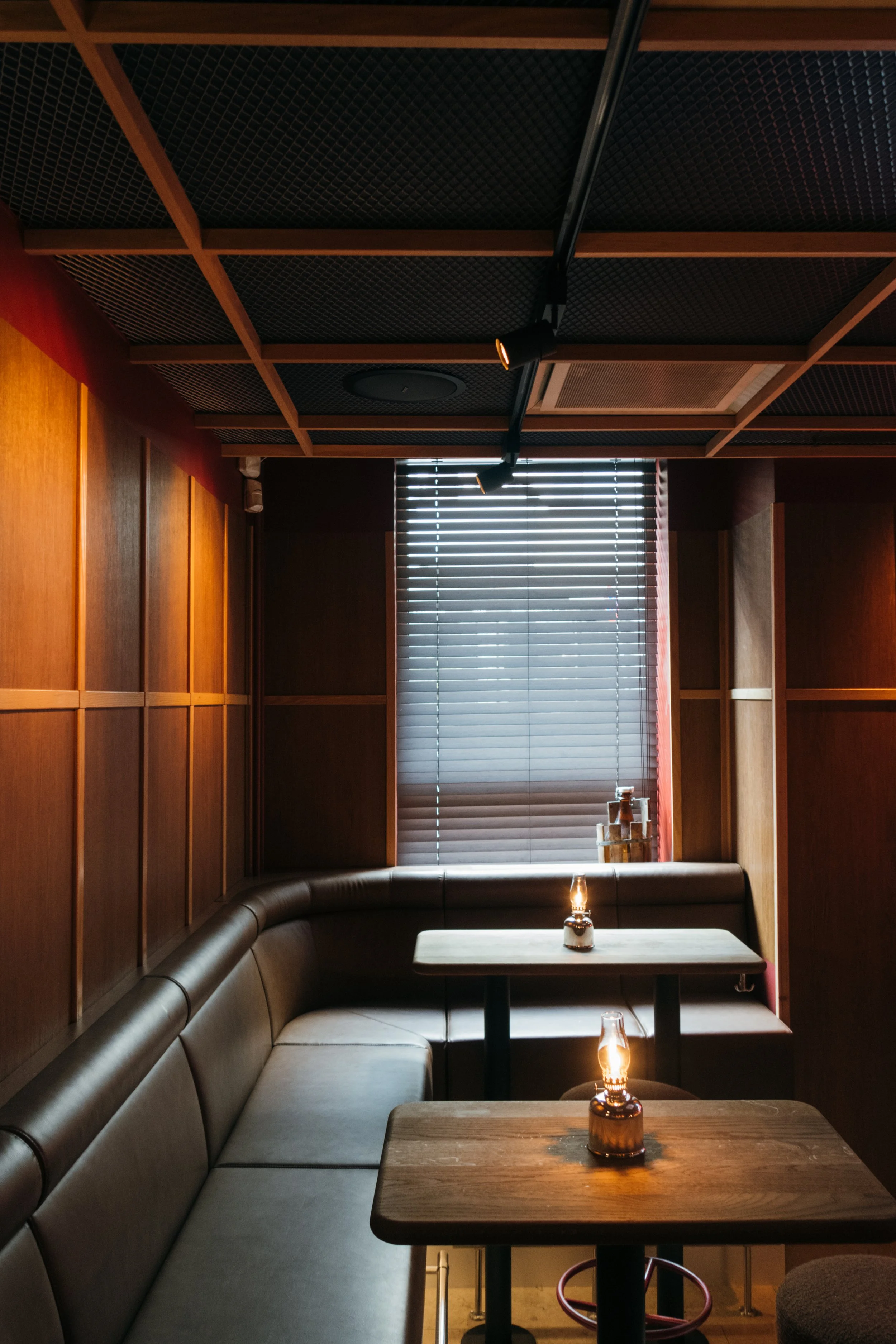
I have somehow missed the front door on my way in, stumbling instead through the back entrance. The interior is so intimate and homely that I feel as though I’ve trespassed into someone’s living room – a design concept that I’ll later discover is entirely intentional. The bar holds a striking amount of character for a venue that’s only been open for two months. The first thing I notice is red. And wood. Everywhere. The ceiling and walls are painted in a deep wine hue, balanced by oak panelling and chocolate leather seating. It immediately envelops you in and eases you out.
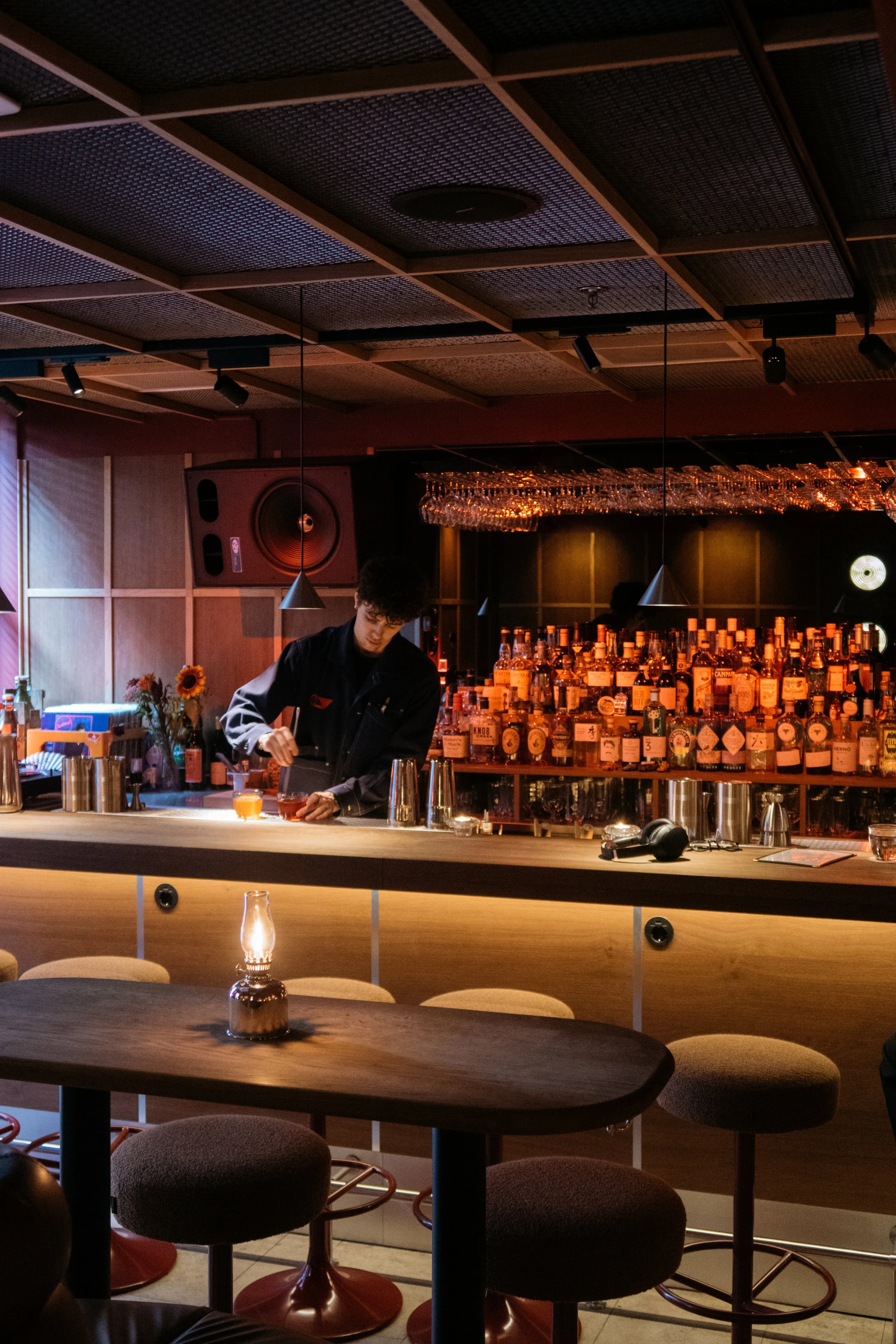
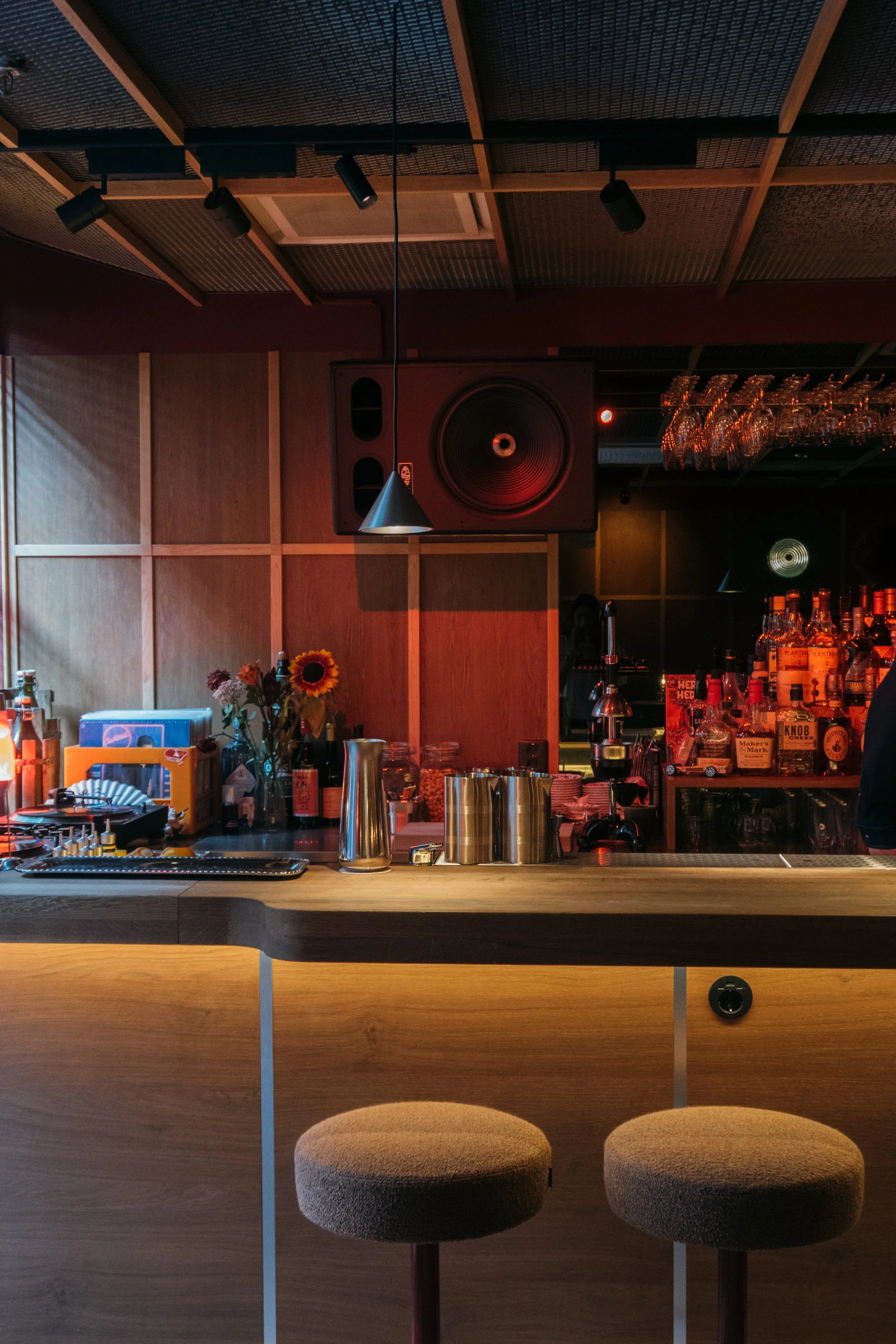
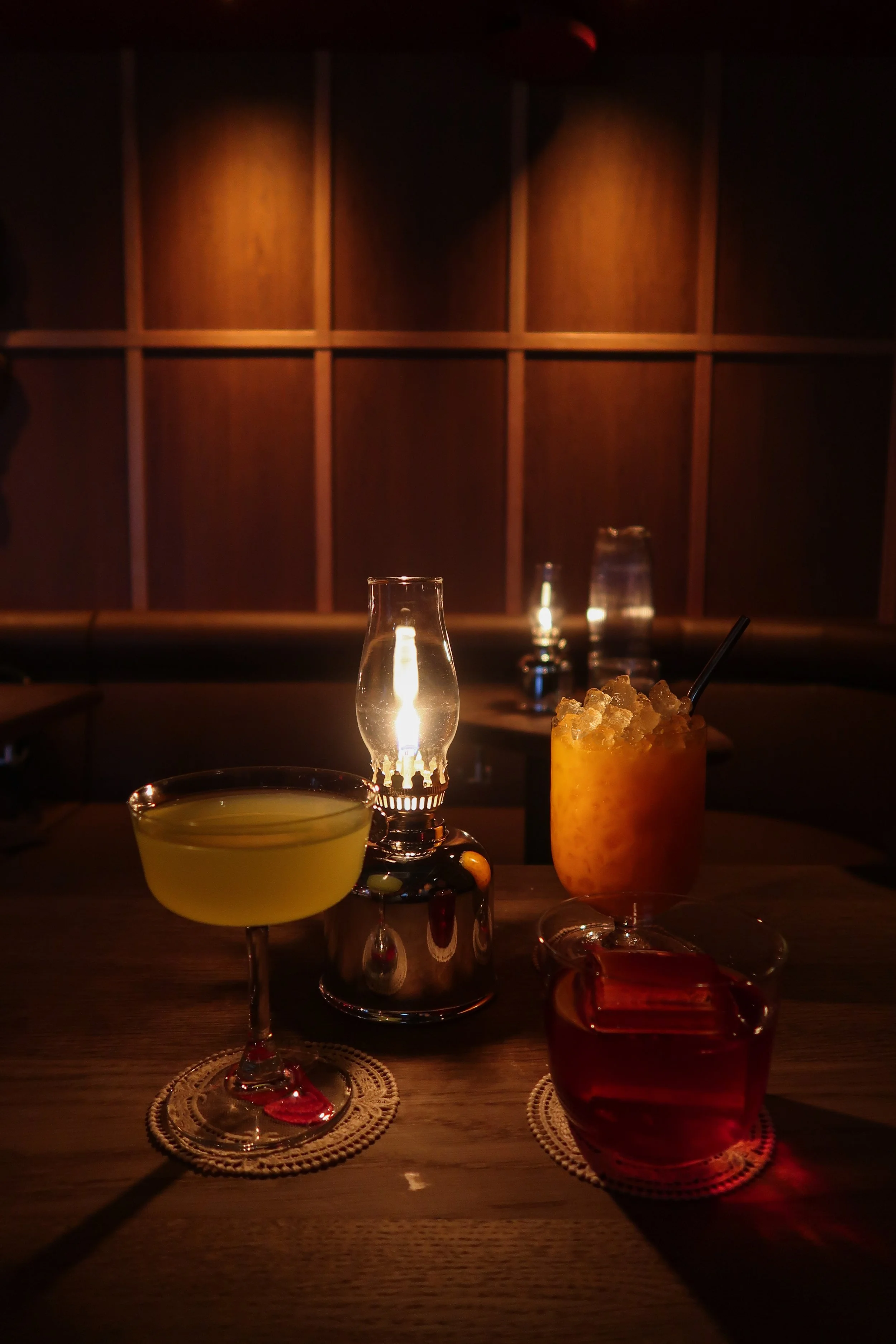
Behind the counter sit Bar Kabinett’s most prized possessions: spirits, high-fidelity speakers, and a collection of vinyl records. Doilies, laced and crocheted with the bar's logo, replace standard coasters, while lighting is nostalgically provided by kerosene and lava lamps. After five minutes of silence, the door opens and Oscar bounds in. His presence matches that of his space: warm, welcoming, vibey.
THE JOURNEY
Bar Kabinett is a small departure from Oscar’s usual surroundings, but a large leap in his career. After years working in some of Stockholm’s most beloved bars, the 28-year-old has branched out to open his own. The journey has been nine years in the making – one that began humbly, washing dishes at Mister French. What started as a temporary summer job soon became the catalyst for Oscar’s career, giving him an ardour for cocktails, a network of contacts, and an affinity for the nocturnal work life. “I worked hard at Mister French for a year, trying to make my way towards becoming a bartender,” Oscar tells me. “I created the whole drink menu, or like nine out of twelve drinks. I asked the bar manager, ‘So, can I become a bartender now?’ and he's like, ‘Well, you kind of have to because you're the only one who knows the drinks.’ I then quit two weeks later...”
The timeline of Oscar’s resume remains somewhat murky despite discussing it in detail. The years blur, the venues overlap, and the names of people he’s met along the way are plentiful. We bar hop from one story to the next, an accurate reflection of the wild unconventional whirlwind that is the hospitality industry. He tells me about his junior years at Le Hibou at Bank Hotel, where he met his mentors, now friends, Alex Skarlen and Ola Carlson (co-founders of Stureplan’s speakeasy, Lucy's Flower Shop). “We bonded over inedible carbonara. At 20 years old, I sent a plate back at a prestigious Italian restaurant here in Stockholm. Ola liked me from then on,” Oscar chuckles. “I think Alex and Ola’s plan was to take me under their wing and train me up until I was ready to move over to Lucy’s,” he adds.
Now, the student has become the master. Voted Bartendernas Bartender for three years in a row (2024-2026), Oscar has emerged as one of Sweden’s most decorated and distinguished names, having also claimed Bartender of the Year at the 2025 Bartenders' Choice Awards. Yet despite the accolades and acclaim, Oscar remains remarkably modest. He's quick to attribute his success to a supportive inner circle: Charlotte for the tasting invites, Eric Ess for having fun, Alex Skarlen for lessons in hospitality, Oskar Gejler Bofride for his quickness, and Ola Carlson for his logic and mathematical mind.
“If I encouraged the perfectionist side of myself too much, I would never put a single drink out.”
THE EXPECTATIONS
I wonder how it must feel to be nominated and critiqued, not only by your peers, but by your competitors too. Does it add pressure? Set higher expectations? According to Oscar, yes, apparently so. “Winning gives me the opposite of confidence,” he laughs. He tells me about a recent seminar that he attended, hosted by Josephine Sunglo, the founder of Afterglow. “She talked about post-award depression and the pressure that builds up afterwards, which I really recognised and related to. When people come in and ask, ‘Oh, I saw you won some awards, why?’ Well, that's not up to me to answer.” When stared down by imposter syndrome and perfectionism, Oscar chooses to look the other way. “I could work on something for a year,” he admits. “But if I encouraged the perfectionist side of myself too much, I would never put a single drink out.”
Riding the wave of his success, Oscar pitched Bar Kabinett – a concept he’d been dreaming of for four years. “Stuff happened a bit too quickly, with getting well recognised in the Swedish community but also internationally,” he says. “It was ‘now or never’ in a sense.” He started by putting pen to paper, theorising his ultimate dream bar in eight written pages. He met with investors, building managers, and soon enough, Grev Turegatan 30 was his. When I ask him how it feels to arrive at this moment, he’s entirely cool about it: “I'm 28 now, so two years earlier than my goal, which is good!”
Money isn’t the only bottom line for Oscar. It’s his reputation, too. “You start doubting yourself with everything you do, especially when you move away from having others,” he tells me. There’s no shifting blame, no fronting friends; the buck stops entirely with you. Flying the coop is inevitable, but how do we know when it’s time to go? How do we make that jump? Oscar’s composure continues to be his secret weapon, along with his gut. “Throughout these weeks, I’ve learnt to trust myself and trust my instinct,” he says. “I went into this thinking I was going to hit the wall by the second month. I thought I’d be crawling on my knees or in the hospital. But I'm still here…so that’s a positive!” The workload is immense, yes, but so is the reward. “Every day I come in, I think, ‘Shit, this is mine.’ It’s unreal,” Oscar says, shaking his head. “We did this. I did this.”
THE MAN
It’s not long into our conversation that I realise Oscar is a fiend for knowledge, an enviable polymath who is naturally good at everything. Curiosity and creativity are innate to his being; bartending is simply the byproduct of this. He’s a self-proclaimed bookworm, or at least he used to be. He tells me how he was a “pretentious teenager” who read a lot of difficult stuff, including Russian classics and Greek philosophy. “I was very good at school. I read Kafka and I read Platon. I thought it was very interesting...I still do,” he tells me. “Philosophy was one of the things that I was supposed to study, but then I began working full-time and it was too difficult to do both. I still want to try it at some point in my life though.”
Before he fell in love with bartending, Oscar flirted with the idea of becoming a chef. “I always liked cooking,” he tells me. “I originally wanted to go into the food part, but then I started meeting chefs and noticed they’re behind the scenes. I wanted the guest relationship part – it's more fun.” Not only does Oscar find comfort in caring for patrons, but he enjoys the protean lifestyle that bartending brings, too. “No evening is the same as the last,” he says. “There's always a new question – someone challenging your knowledge or challenging you as a person. That's what I enjoy the most about it.” For a man who loves to learn, there are certain elements of the job that Oscar will never be a fan of – accounting being one of them. “I get chills when I see it...it’s the worst thing I know,” he shudders. But mostly, bartending is a freeing and expansive landscape where, as Oscar says, one can do whatever they want, become whoever they want and work wherever they want.
Behind every great man stands an even greater woman. For Oscar, it’s Hjördis: his high-school sweetheart and fiancée, and the mind behind Bar Kabinett’s graphic identity. Taking inspiration from their home together, Bar Kabinett reflects not only their space, but how they like to host in it. “We often do too much food, and too much drink,” Oscar shares. Despite once hosting a legendary dinner for twelve in a 26-square-meter apartment (Oscar’s first apartment on his own), he hasn’t always had the flair for it.
Raised by a single mother, the concept of large family-style dinners was an absent one. It wasn’t until he met Hjördis that he was pulled into the world of family gatherings that felt like “proper, proper parties”. He recounts them to me like Carroway recounts Gatsby’s. Whisky is poured at six o'clock every Saturday. Through the revolving door of guests, you may encounter a retired ballerina who lives in the forest, an Arabic-speaking grandfather, or a dude who makes his own hotdog meat and charcuteries. For Oscar, there is far more fun to be had in hosting a party than attending one. If you're swinging by his home, you’ll most likely be greeted with a freezer-style martini or a negroni – “something easy to prepare and pour up”. On the menu will be one of two things: pasta or a Florentine-style steak. No dessert – Oscar’s not a fan. If you happen to score a New Year’s invite, congratulations, they’re going fancy with lobster and oysters.
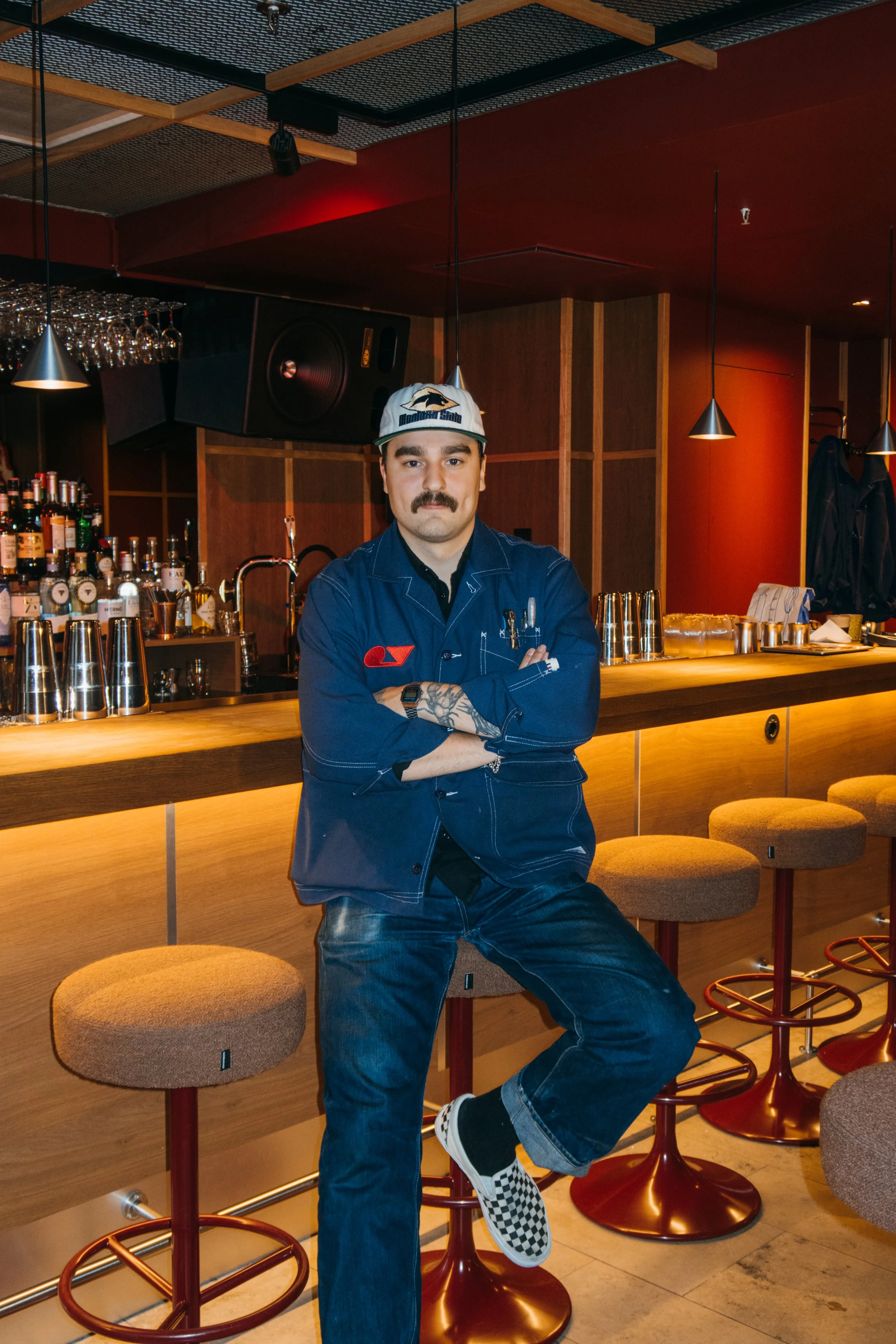
Oscar loves hobbies and Sundays (his day off). His favourite pastime includes 3D-printing, an obsession that led him from printing speaker cabinets to simply just building the speakers himself. “How Henry Cavill of you”, I tell him. These days, he’s into textile and rug-making, having just blown his latest paycheck on a tufting gun. He points to an abstract rug hanging on the wall adjacent to us. “That’s Hjördis’ creation!” he states proudly. There’s a biophilic and yonic vibe to it. It’s beautiful and expressive – and up for sale! In fact, most of the artwork in Bar Kabinett is.
“I want to support young and local artists who don't have the possibility to exhibit somewhere else,” Oscar tells me. “We don’t take a cut; we just do the contact between artist and buyer.” The initial plan is to offer a three-month residency on the walls, allowing artists to showcase whatever they choose (within reason) and earn a little money in the process. The maths is simple. “We've been doing about 600 guests in one week”, Oscar tells me. “That means there’s 600 people that get to see your artwork every week. Sure, it’s nice having it in a gallery but there’s only so many people who go to galleries. And it’s usually the same old man or woman who’s simply there for the free prosecco.”
THE BAR
Not all guests value conversations with their bartenders. The awareness of this is what separates a good bartender from a great one. Same with Uber drivers. When it came to handpicking his team, Oscar prioritised sociable people as opposed to just skilful bartenders. “Bartending is more about the tending of the bar than just making good cocktails. I mean, the definition is in the word, right?” he remarks. “Some people are super creative and make really delicious drinks, but they're weirdos who can't take care of people; they're super introverted and they just want to work in the dispensing and pushing out of drinks. Others are very shit at making creative drinks... but they're better at making people feel more comfortable and at home.”
His great source of advice comes from something a drag queen once told him: “Service is a balancing act between being dominant and submissive.” It's a dance of personality dynamics, letting one person lead and the other follow, until the song changes, and the roles reverse. “That's what I was looking for with the people that I hired,” Oscar tells me. “I’m working with people I’ve never worked with before, but they've succeeded my expectations. I think we can help each other become not only better bartenders, but better people.”
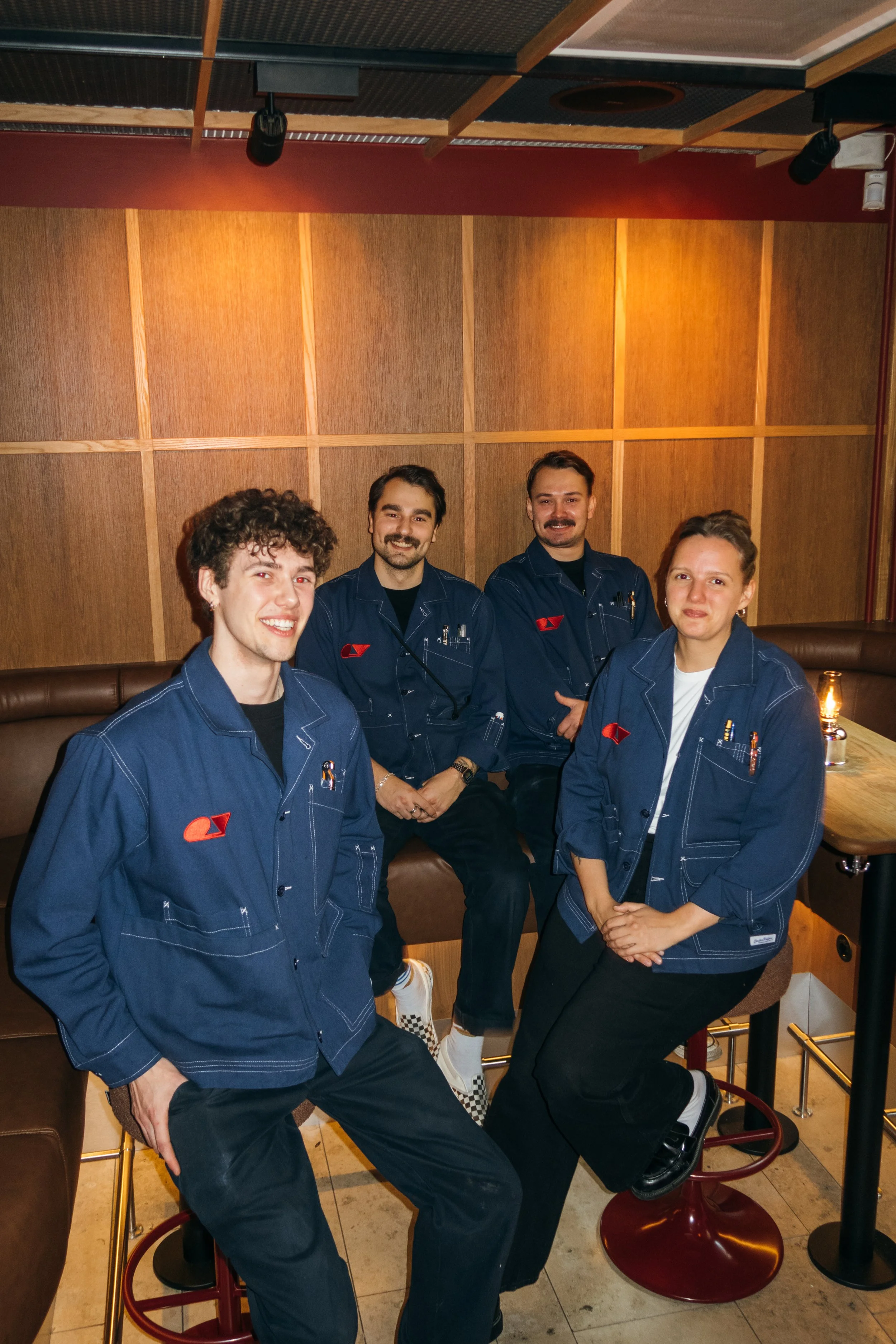
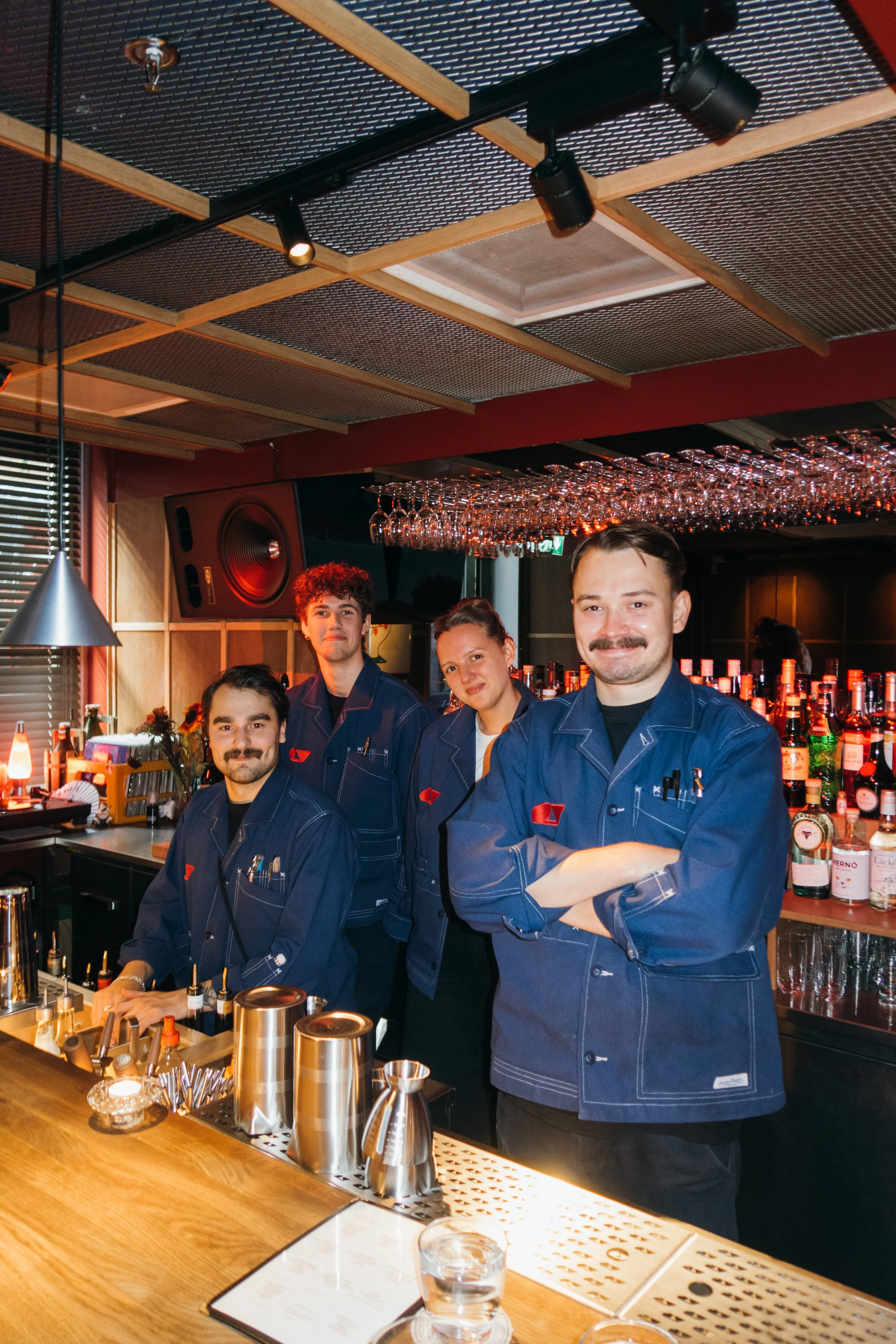
Oscar has a strong aversion to the word mixologist, so I’ll call him a super cool booze maestro instead. The cocktail menu is considered, experimental and ambitious – without the pretentious mumbo jumbo. The subtlety of flavours belies days of fermenting and taste-testing; every sip infused with months of research and development. Some of the drinks are an amalgam of vibrant Asian profiles and classic Swedish ingredients. Take their Kojitini, for example, where they make their our own Kōji (cultured rice) and use it for dilution – bringing a rich umami depth to an otherwise classic martini. Or their Whisky Highball, which pairs Suntory Toki with a house-brewed soda made from Swedish apples and hōjicha, a roasted Japanese green tea sourced from a small shop on Södermalm.
Many of the drinks are also built around seasonal fruits and berries. Currently featured on the menu is a Rhubarb & Sherry Cobbler – a classic American cocktail that first appeared in print in the 1800s, when a Canadian traveller recorded it in her diary following a trip to upstate New York. “When Swedish rhubarb was in season, I bought 80 kilos of it,” Oscar tells me. “Once it’s gone, it’s gone, and we’ll move on to something else.” My guess is plums, considering his next admission is that he bought 40 kilos worth of them last week. He drops another hint. “I also bought 20 kilos of Swedish tomatoes, because they're in season now. I might do a secret Bloody Mary, or a pickled Michelada (one of my favourites) topped with beer and a pickled soda.” Another personal favourite of Oscar’s that’s currently on the menu is the Kallt Kokkaffe (Cold Brew Coffee), inspired by the traditional northern Swedish practice of melting snow and boiling it over an open fire with coarsely ground coffee.
Fermentation takes weeks; vinegars require months. It’s a funny paradox given that bars move fast and drinks are consumed quickly. Yet there is a quiet power to this slowness, along with an addictive excitement for the unknown. “You have time to think about the drink and develop it,” Oscar explains. “When you try something new that you haven't seen done before, it's interesting. You also don't know what it's going to taste like because you've never tasted it before.” It really is a biochemical magic trick – a benign form of rot. Of course, fermentation itself is nothing new, and neither is the use of vinegar in cocktails. “It has been done for over 150 years,” Oscar notes. “I think the earliest traces of vinegar date back to the Babylonian Empire—it’s been part of human consumption for quite some time. For us, it’s simply about how we can make it more palatable for people.” It's this exact notion that grounds the entire cocktail menu at Bar Kabinett: keep things classically rooted but apply modern techniques to it. “It’s Hegel’s dialectical theory,” Oscar laughs. “Everything starts with the classics, moves towards extremes, and eventually finds a new balance that combines the best of both worlds.”
“I think we can help each other become not only better bartenders, but better people.”
Although you may come for the drinks, they may not be the reason you stay. In Oscar’s words, “drinks are the last priority”. When we recall a memorable moment, a large part of that recollection is shaped by how we felt. Who were we with? What were our surroundings? “Ninety-nine times of a hundred, I don't remember what I've had to eat or drink, but I do remember the place I was drinking or eating at more,” Oscar says. Music sits at the heart of Bar Kabinett’s offering. It flirts with the idea of an old-school jazz bar whilst honouring the power of vinyl.
"I bought records before I could even play them,” Oscar tells me. His early listening days mirrored those of anyone with good taste: Bob Dylan, Johnny Cash, The Beatles. Over the years, he slowly found his way from country and folk to old-school blues and jazz. Now, he buys far too many records for his own good. “I accidentally bought three more yesterday,” he sighs. “But what I like about vinyl is that you listen to the whole record instead of just one hit song. There are so many good songs that you would never discover if you didn’t listen to the whole record.” On any given night, should you stumble into Bar Kabinett, you might find yourself listening to anything from Sonny Rollins and Max Roach to Louise Armstrong covering Disney songs, or the studio album Star Wars and Other Galactic Funk. “When people don’t react to those, it’s even more fun,” Oscar laughs.
With all his accolades and a two-month-old bar under his name, Oscar Jonsson Buhre could take it easy for a while, but it doesn’t sound like he will. This is what's currently on his radar: host a live jazz session, collaborate with local record stores, and get brainstorming on the bar's outdoor space. After all, every effort and endeavour comes back to a singular mission: Bar Kabinnet is meant to be enjoyed. While Oscar hopes you leave a “little bit happier and a little bit drunker”, his true wish is that you walk away having learnt something – whether it’s from the staff, the space itself, or the company that you came with. “I want you to forget space and time,” he says. “Maybe you come and sit down for two hours and have a chat, or maybe you come to the bar and enjoy a drink by yourself. Either way, you forget about the outside world and your problems in it.”
Bar Kabinett
@barkabinett
https://barkabinett.se/
Grev Turegatan 30, 114 38 Stockholm